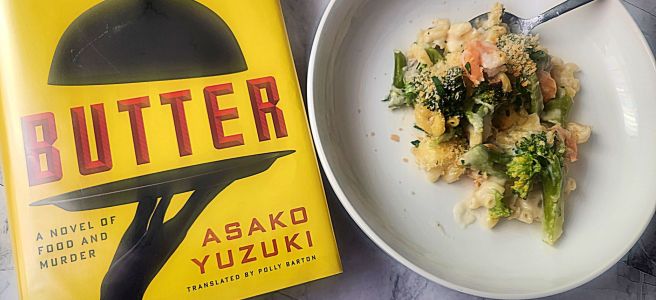
I think in most cultures, women are expected to be a certain way, even if it isn’t consciously expressed or even consciously thought. The concept of women being the gentler, kinder sex, that women are soft, feminine, sweet, motherly, domestic goddesses whose ultimate life goal should be marriage and children, is as strong today as ever it was in the past, perhaps even more so given our current political environment. That’s not to say that every single person believes that, nor it is to say that it’s the truth. I know plenty of women, myself included, who are happily childless, and I know plenty of women who are happily mothers and wives. To me, it’s your choice as to what you want to do with your life. In this book Butter, that expectation and choice are subverted in the most fascinating way.

Set in modern-day Tokyo and surrounding villages in Japan, the storyline starts with magazine journalist Rika Machida who wants to write an article on serial killer Manako Kajii, who is accused of murdering the wealthy old men she supposedly lured on dating websites, cooked them lavish meals and had them take her to expensive restaurants, got them to give her vast sums of money, and then killed them. Well, there is the question of whether Manako really did kill them, as their bodies were discovered under mysterious circumstances. She is imprisoned at a detention facility when Rika approaches her, not directly for an interview but more subtly by asking for Manako’s recipe for boeuf bourguignon. Thus begins a very odd and ultimately symbiotic relationship between the two women. Manako is seen by society as being old, unattractive, overweight and the general consensus in Japan is “how could this ugly, fat woman entice such men into being with her?” Her real crime seems to be that she is unashamedly “fat,” although if you start to analyze the characters weight, you realize that what they really are is not uber-skinny, which seems to be the ultimate beauty standard in Japan, as represented in this book anyway.

Manako begins to subtly manipulate Rika by sharing stories and anecdotes about good food, particularly her love of butter and Rika in turn develops an obsession with learning more about Manako, beginning to internalize everything that Manako shares with her, her views on men and women and their societal roles, her beliefs about body image, hers and those of others, and of course, the role that good food plays in our lives. There is a strong theme of misogyny running throughout the book, as several characters, mostly male, express contemptuous opinions about women’s appearances, focusing on weight. Rika has always been extremely skinny, which again, is presented as being the ultimate beauty standard in Japan. As she grows more attached to Manako and continues talking with her and learning more about Manako’s upbringing and family and her love of food, Rika begins to eat more, cooks more, enjoys her food more, and gains weight, which is commented on by numerous characters.

The food descriptions are equal parts lavish and visceral. One section, where Rika travels to Manako’s home village to learn more about her upbringing, goes into detail about milking cows, with the reminder that milk was once part of the cow’s blood, which was something I never knew before. There are luscious descriptions of butter woven throughout the book, naturally. Butter mixed with soy sauce and lavishly poured over cooked noodles. Butter as a binder in a luscious French vanilla cake. Chicken braised in butter, unctuously oozing fatty, buttery juices. A luscious hollandaise sauce made up of butter, vinegar and egg yolks for dipping lightly roasted asparagus. So many wonderful food descriptions made my mouth water constantly and even as I write this, I’m craving some golden, salted butter on a slice of toasted sourdough.

I was surprised to learn that this book was inspired by true events. In 2012, the case of the “Konkatsu Killer” made headlines throughout Japan. The case and the subsequent reaction of the public are pretty accurately reflected in this fictionalized version. The obsession with weight and looks specific to women in society are depressingly spot-on and you see this in so many of the characters – men and women alike – in Butter. It’s a lengthy, meandering read and there are parts that go on far too long, but overall I found it be quite compelling. Manako was a very dislikable character, though you do end up pitying her a bit at the end when you realize what a truly lonely and sad person she really is. Rika, who starts out being somewhat one-sided, evolves her world view as a result of her interactions with Manako and starts to really not give a shit about what anyone in society thinks of her, and with this acceptance and freedom, ironically becomes much more attractive to her family and friends alike who previously thought little of her.

Obviously, the central themes in this book are food, self-image, and ultimately, acceptance of one’s self. We all live in a society that is obsessed with looks, with youth, with weight. Both men and women can be pigeonholed into this mentality of having to fulfill certain expectations, which can be compared to the prison where Manako is being held, and the prisons we all create for ourselves when we try and assimilate ourselves into the roles and expectations that others try to force upon us. Women in particular are either criticized or ostracized when they step outside of those expectations tied to looks, to weight, to the expectation that they have to be married and a mother to be truly fulfilled, which is ridiculous. Fulfillment comes from loving yourself and accepting yourself for who you truly are, which is a good goal to aim for in this life.

As part of her journey into self-acceptance, Rika begins dealing with traumatic memories of her father’s death. She found him dead in his apartment when she was a teenager after an argument, and she has carried guilt with her into her adult life. She finally starts to realize that his death was not her fault, as her father became a terrible alcoholic after her parents got divorced. Her guilt is tied to a promise she made her father before he died that she would cook him a dish she learned to make in home economics class – macaroni gratin with prawns and broccoli. She describes this to Manako during one of their interview sessions.

“You fry chopped onion dusted with flour in butter, and stir in the milk a little at a time. When that’s all absorbed, you add in the macaroni and broccoli boiled in salted water, and prawns simmered in white wine. Then you pour it all into the gratin tin, sprinkle it with cheese, breadcrumbs and parsley, and bake it in the oven for twenty minutes, if I recall correctly.”
I love a good macaroni and cheese, which is essentially what this dish is. I’d never made mac and cheese with shrimp (which are basically the same as prawns) nor with broccoli, so I decided this dish would be the perfect foodie homage to the book.

INGREDIENTS
30 raw shrimp, deveined and tailed
1 cup dry white wine
1 head of broccoli, divided, chopped, and cooked in salted water for 12 minutes
1 tablespoon olive oil
1/2 stick butter
1/2 red onion, finely diced
Salt and pepper to taste
6 tablespoons all-purpose flour
3 cups milk
1/2 cup heavy cream
8 ounces uncooked elbow macaroni
1 cup each of shredded Gruyère cheese, shredded Parmigiano Reggiano cheese and grated mozzarella cheese
1 cup panko breadcrumbs
Fresh parsley and fresh chives for garnish
METHOD
Marinate the shrimp in the white wine for 10 minutes, before heating the wine and poaching the shrimp for 1 minute. You don’t want to cook them completely as they will continue to cook in the gratin. Set aside and keep the wine handy.

Heat the butter and olive oil in a large pan over medium heat, and add the diced onion. Sauté for 5 minutes, then sprinkle over the flour and cook until the flour is no longer raw, but don’t let the flour brown too much as it will affect both the appearance and the taste.

Slowly add in the milk, stirring well after each pour, so that the milk melds with the flour and butter. Stir or whisk as you add the liquid so that the mixture doesn’t clump.

Add in the heavy cream and the wine to the mixture and continue stirring. The sauce will thicken as it cooks, turning into a beautiful pale roux. Season with salt and pepper and taste to adjust the seasoning as needed.

In another large pot, bring 6 cups of water to a hard boil and add the macaroni. Add salt lightly to the water and let the pasta cook for 8-10 minutes. Drain when fully cooked and add to the roux sauce.

Add the cooked broccoli and the poached shrimp to the mixture and stir well to combine. Transfer the mixture to a buttered casserole dish.

Heat your oven to 425F. Sprinkle the grated cheeses over the shrimp-broccoli mixture generously, then sprinkle over the panko breadcrumbs.

Bake for 15-20 minutes, or until the cheese and breadcrumbs have turned a lovely golden color and the smell wafts up to you.

Garnish with fresh parsley and chives and dive in. It’s a deliciously decadent meal, one that begs to be shared with whichever female serial killer is nearby. Gochisousama!


 Food In Books
I just finished reading the book and I’m really excited to make this dish for my book club tonight! Quick question in the photo where you’re putting in the Panko breadcrumbs, it looks like cubes of something on top of the dish. Is that butter or cheese?
LikeLiked by 2 people
I’m glad you enjoyed the post. Those cubes are mozzarella. I didn’t grate that cheese because it was so soft. Easier to cut into cubes. I’ll update the recipe to reflect that. I hope your book club enjoys the dish!
LikeLike
My long comment was just dropped by WP! So I’m trying again – just to say that I loved your review of this fascinating read, and the recipe is the epitome of comfort food! Thanks for both recommendations. 🙂
LikeLiked by 1 person
Thank you so much and I’m glad you enjoyed the post.
LikeLiked by 1 person
Fascinating! The recipe looks amazing–everything’s better with butter–the tagline/commercial of my childhood TV-watching days. 🙂
LikeLiked by 1 person
I could not agree more. Butter is god.
LikeLiked by 1 person
It’s really excellent.
LikeLike
this sounds like a. book I’d love
LikeLiked by 1 person
I found it quite compelling, though it could have been cut down in some sections. The food descriptions are mouth-watering. I think you’d enjoy it!
LikeLiked by 1 person