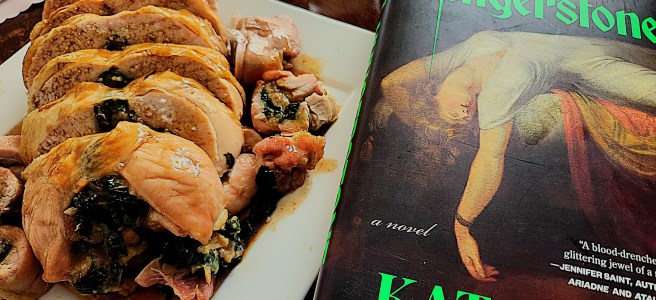
Being a former Goth, I love me a good vampire story. Dracula, of course, is the big bad granddad of all bloodsuckers, IMHO, but he was preceded by that chest-biting lesbian vampire Carmilla; her eponymous book written by Irish author Sheridan Le Fanu and published in 1872. Carmilla was unique to its time when it came out, focusing not only on a female vampire who is just as predatory as any male counterpart but also demonstrating a rare (and possibly unintended) sense of female power in both of its main characters. Kat Dunn has taken the tale of Carmilla and revamped it – pardon the pun – into a tale of feminism and reclaiming one’s sense of self. Hungerstone tells the story of Lenore, married 10 years to Henry at the height of the Industrial Revolution in Victorian England, and not at all happy in her marriage or her life.

The plotline is similar to Carmilla in that she has an accident in front of Henry and Lenore’s country house and is taken in as a guest, but this version of Carmilla is far more aggressive. She turns Lenore’s household upside down with her odd behavior and requests. She is not respectful to Henry, which of course angers him as he is an arrogant bastard of a husband who alternatively is horrible to Lenore or kisses up to her when he wants something. Lenore herself has had a very traumatic childhood, having witnesses her parents die in a gruesome and bloody carriage accident. Her entire life has been marked by blood in some fashion or other, and it is this grim and vital aspect that has drawn Carmilla to her.

Lenore’s married life is one of repression. She is still in love with Henry, though he makes it quite clear the feeling is not mutual. It’s patently obvious that he is having an affair with Cora, a young friend of the family who professes to be Lenore’s friend. It got quite irritating after awhile, seeing Lenore deliberately blinding herself to what was going on between Henry and Cora, and it takes her frequent interactions with Carmilla for her to gain self-confidence and call them both out on their behavior. Lenore is both repelled by and drawn to Carmilla, exemplifying that tension between desire and fear that runs through so many vampire -and indeed, Gothic – novels.

It turns out that Henry has been deliberately poisoning Lenore by giving her pastilles dusted in sugared arsenic so that he can marry Cora, whose father has significant wealth. No wonder she feels sick and exhausted on a daily basis and is constantly vomiting blood. We come to learn that the reason Henry hates Lenore so much is because she holds power over him. She saw him murder a man and essentially agreed to cover it up in exchange for the benefits of marriage, but Henry cannot stand that someone would have something over on him. He’s really a very unpleasant character, but he is meant to be despicable.

As Carmilla continues her stay with Lenore and Henry, young girls in the surrounding village begin acting out in the strangest and most disgusting ways, consuming hair and forest animals, among other things. Their hunger is, of course, a result of Carmilla taking their blood and creating this unnatural hunger within them, mirroring her own and that of Lenore. I actually enjoyed these sections, gross as they were, because it gave a new twist on the classic vampire trope of hunger and consumption and ingestion. But don’t read these sections while you’re eating. 🙂
At the risk of offending all those vampire literature lovers, I really found the original Carmilla to be quite dull, and so I went into Hungerstone a bit apprehensive that I’d be as bored. Hah! Not at all. This book is fast-paced, visceral with mentions of blood, death, appetites both sexual and for blood, and many luscious foodie mentions. It makes sense if you think about it. An appetite for blood, a lust for physical and sexual connection, and a desire to consume delicious food can all be seen as different sides of the same thing – hunger. Hunger is the primary theme of this book and it manifests in many ways, both pleasurable and quite gruesome at time. Once Lenore and Carmilla have consummated their relationship, Lenore’s appetites for sex, for blood and especially for food, overwhelm her but most pleasurably.

“We eat robustly: chicken ballotine, boiled salmon with mousseline sauce, cauliflowers à la crème, potato dauphinoise, then a smart charlotte russe, bavarois aux pêches, cheese, heaped bowls of cherries and strawberries, delicate raspberries and thin slivers of pear and apple. A bottle of red wine is followed by a bottle of sherry, my glass forever full and my plate forever teeming…….there is joy in food, tonight, but that is all – a simple pleasure that need serve no other purpose.”
I was intrigued by the mention of chicken ballotine, which I had never heard of, and learned that it is an entire deboned chicken, legs and breast and thighs included, which is stuffed, rolled and baked. This sounded delicious, but I had shit luck in finding a butcher who could debone the entire bird without cutting it into parts. So I settled for a stuffed breast and two stuffed thighs, which is essentially a whole bird anyway. Gimme a break here!
INGREDIENTS
1 large deboned chicken breast, skin on
2 large deboned chicken thighs, skin on
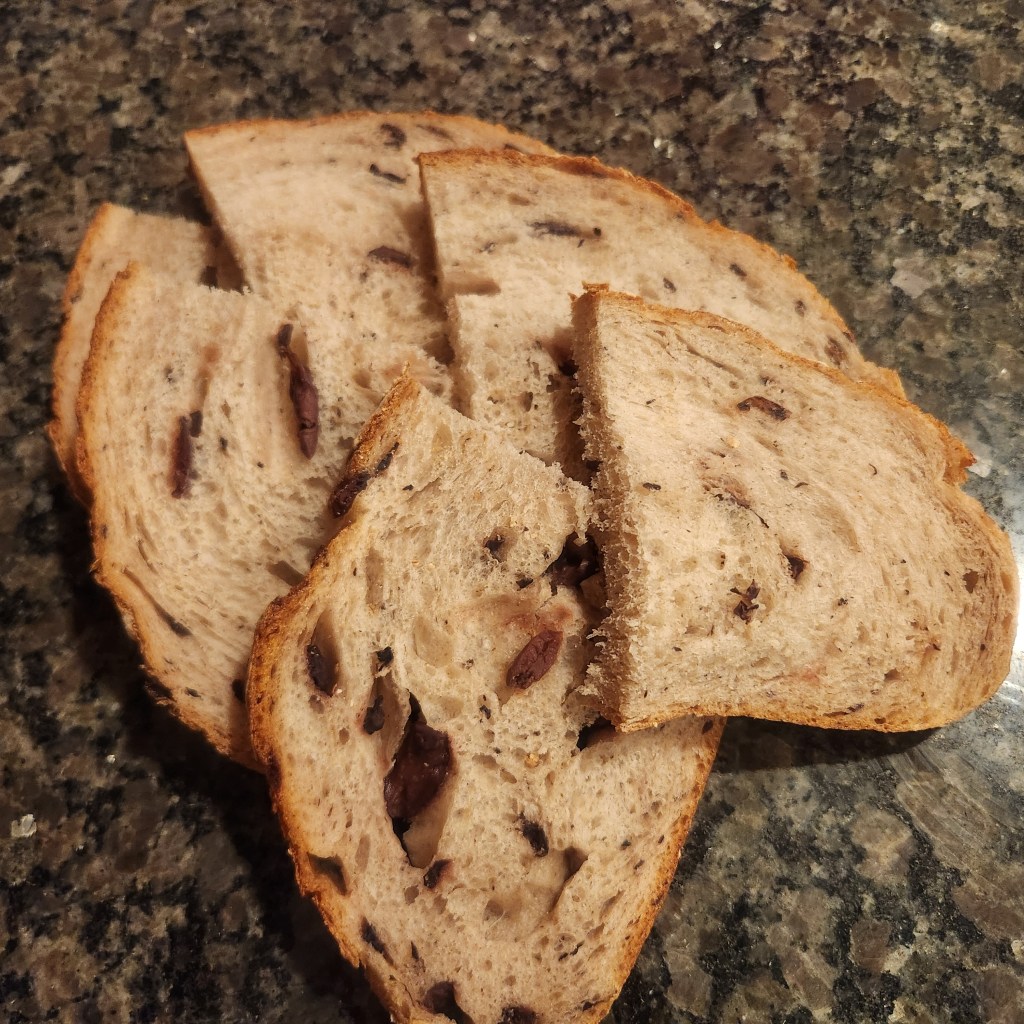
1 cup cubed bread (I used homemade olive bread)
Salt and pepper
1 Tablespoon olive oil
1 large shallot, finely minced
4 cups fresh spinach leaves
1 cup grated Gruyere cheese
1/2 cup dry white wine
1/4 cup chicken stock
1/2 tablespoon cornstarch
2 tablespoons tamarind soy sauce
METHOD
Preheat your oven to 400F and lay the chicken pieces skin-side down on a plate or board. Sprinkle with salt and pepper.

In a large pan, heat the olive oil and sauté the shallot for about 5-7 minutes so that it browns lightly but doesn’t burn.

Add the spinach, stir, and cover to allow the spinach to wilt, about 5-7 minutes.

Add the Gruyere and bread cubes to the spinach, and stir to mix. Remove from the heat.

A spoonful at a time, stuff the chicken pieces with the spinach-cheese-bread mixture and spread so that the meat is well covered.

Roll up the chicken pieces and tie with kitchen twine. Put into a large glass or metal pan, pour over some olive oil and a half-cup of chicken stock, and roast for 45 minutes to an hour, checking to ensure the breast isn’t dry.

Remove the chicken from the pan and let rest on a platter, and pour the oven drippings and scraped-off brown bits into a metal pan over medium heat. Add the chicken stock and wine to the drippings in the pan, let boil for about 5 minutes to reduce, then stir in the corn starch and soy sauce. This will thicken and become a nice gravy.

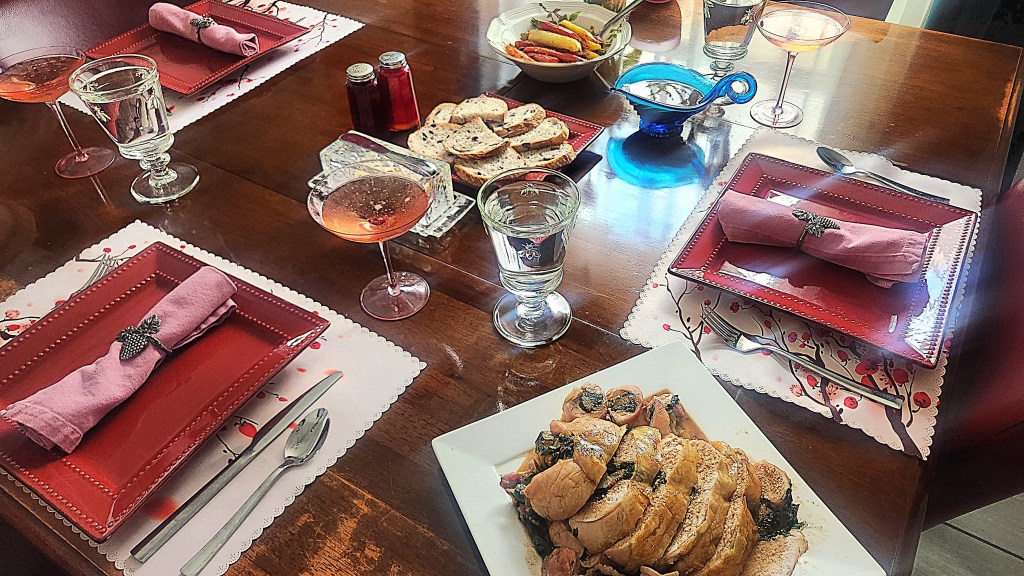
Remove the twine from the chicken parts and cut into thick slices. Arrange on a platter, and pour over your tasty gravy, then serve with buttery mashed potatoes and roasted rainbow carrots. A delicious and hunger-satisfying meal that will surely keep you from going and sucking out some poor girl’s blood. Or will it………


Yeah the chicken was little macabre 🙂
LikeLiked by 2 people
🤣🤣🤣 By design, I assure you.
LikeLike
I love the way you put the chicken back together! For some reason, it just struck me, lol! I didn’t know there was a vampire story I’ve never read! Thanks again for a lovely post!
Mollie
LikeLiked by 1 person
Thank you so much for the compliment.And I’m glad you liked the post.I thought the chicken looked a bit like a weird creature.But that’s appropriate for this book. I think you’d enjoy this story.
LikeLiked by 1 person
I’ve not heard of chicken ballotine, either, and I love your solution for deboned chicken–looks like it came out delicious!
LikeLiked by 1 person
Why, thank you! I was quite pleased with it, too. I think you could use that method for any type of flattened meat.
LikeLike
I’m so glad I stumbled upon your blog! Firstly I love this idea of cooking what they’re eating I kept wondering what the food Lenore mentioned was like! Secondly I wanted to know beforehand if Henry was cheating on Lenore because I get irrationally ANGRY with cheating tropes and I’m only 25% in and want to be prepared and all signs were pointing to an affair! Your blog is the only blog that I’ve seen even mention Cora! Definitely subscribing and looking forward to other book/food reviews
LikeLiked by 1 person
Thank you so much and i’m glad you enjoyed the post. I probably should have put some sort of a spoiler alert when I did the book review. Yes, Cora was definitely a piece of work…. the nicest thing I can say about her. I’m happy you’ve discovered my blog. Enjoy! Many new posts are in the works. 😊
LikeLike
Wow does that look delicious! A few years ago I made a rolled-up stuffed turkey breast for Thanksgiving and was surprised at how flavorful and juicy it could be. Now I have a recipe for chicken that I will surely save. And I love the excerpt you reprinted from the book. Was the author a chef? She writes about all those dishes so well, she could be a food writer.
LikeLiked by 1 person
I am so glad you enjoyed the post. I’m not sure if the author was a cook as well.But the mentions of food in this particular novel were many and quite tasty-sounding. Your turkey breast sounds delicious! I think you could adapt this one for a stuffed turkey breast anytime.
LikeLiked by 1 person
Yes, I love your choice of spinach. It would go well with turkey. That’s what makes cooking so much fun. The variety.
LikeLiked by 1 person
Oh my gawd! First of all, I’m going to get this book because it does sound spectacular by your discerption. I read Carmilla so long ago, I hardly remember it. I do however remember thinking it needed more action, brashness or something. The recipe looks wonderful, and one I’m definitely going to try. Potatoes dauphinois, I love those too! Thank you for the awesome synopsis on this book 😉.
LikeLiked by 1 person
I have to admit the cover was what intrigued me to start.But the story itself is really good. And the ballotine came out wonderful. Mmmm, potatoes dauphinoise!!
LikeLiked by 2 people
Oh, so glad you liked the book, the post AND the dish! Let me know how it turns out if you do make it.
LikeLike
I literally finished this book last night and loved it. So then I got the notification about your blog post and it was like serendipity. There was so much food in this book, and I like your comment about ingestion and consumption and hunger. Well said. That chicken dish looks super yummy too. Gonna try it for Easter! Great post, again.
LikeLiked by 1 person
Thank you so much! Yes, food galore and many strange appetites in this book. 😁
LikeLike