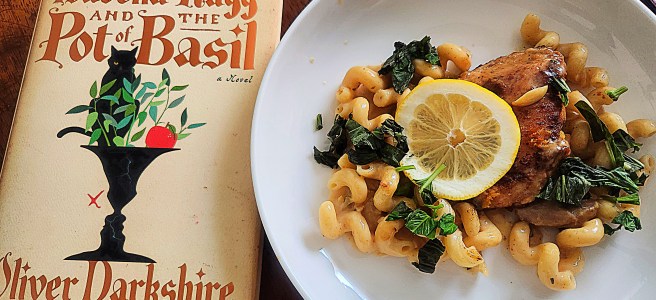
A belated Happy New Year to you all. Sorry I’ve been out of commission so long. I had horrendous back pain all through November until early January. I was also in New Orleans for awhile, and then promptly got the flu when I came home. Fun times! But I am revived (more or less) and back in the cooking and blogging groove. Anyhoo, this book was recommended to me from one of those pop-up store ads you see on Instagram. Having just done some research on medieval and Renaissance Italian fairy tales for my podcast Fear Feasts, I was very much in the mindset of Giambattista Basile and Giovanni Straparola, and of course, the incomparable Giovanni Bocaccio, whose Decameron I recall reading when I was researching my master’s thesis. The Decameron is a collection of 100 short stories told by a group of young men and women in medieval Italy who have secluded themselves in a villa outside Florence during the Black Plague epidemic as a way to protect themselves. One of the more famous stories in the Decameron – the tale of Lisabetta whose lover Lorenzo is killed by her brothers and whose head she keeps in a pot of basil and waters it with her tears of grief – was the inspiration for Isabella Nagg and The Pot of Basil.

A whimsical, humorous and also dark tale full of love lost, magic, goblins, wizards, medieval villagers who are pretty stupid, and of course, many mentions of basil, the book tells the story of Isabella Nagg, married unhappily to Henric and whose only true companionship is her treasured pot of basil. Henric, not the sharpest crayon in the box, one day steals a book of magic from the local wizard, brings it home, and Isabella starts concocting magical potions and spells from it. One of those spells causes her donkey Bottom to become aware and to be able to think and speak, which is one of the funnier sub-plots of the story. This seems to be endemic to the story, because there is also a black cat who speaks. The book abounds with anthropomorphism, but in a good way.

The nearby village of East Grasby has a goblin market at which the local goblins try very hard to sell their goblin fruit to the human villagers. Gwendolyn Gooch (and come on, you have to love that name) takes over the Market and starts what is essentially a pyramid scheme getting the villagers to buy the goblin fruit, even though it will kill them. It’s very Christina Rossetti and her epic poem Goblin Market, which I remember reading in high school. So you get some elements of Rossetti, some elements of Douglas Adams, some elements of Terry Pratchett and Neil Gaiman, and some elements of Boccaccio. I mean, that’s quite a literary goulash right there, wouldn’t you say?

Overall, I enjoyed reading it. I always enjoy a heroine who starts out somewhat clueless and then gets her life together and becomes kind of a badass. Isabella Nagg does become a badass at the end, rescuing many of her fellow villagers from the goblins, from the dead who have started rising, and from their own stupidity. Although it is a whimsical read, it does also deal with some dark themes, the headless body coming back to life at the very beginning, among others. Who the headless body turns out to be is a key part of the overall story, so being the nice person that I am, I won’t spoil it for you. Though if you’ve read Boccaccio or have any sort of brain, you’ll easily figure it out yourself.

There were several food references in the book that I could have taken inspiration from, including tea with milk, porridge, omelettes, the titular basil, of course, and the goblin fruit that is is temptingly described in this passage.

You should not eat the goblin fruit. And yet, it tempted. Always perfectly ripe, it tantalized the senses and caught the light to lure your attention towards it. You must not eat the goblin fruit, but people did, and were lost.
If that’s not the most perfect analogy of human addiction, then I don’t know what is. However, it inspired me to make a dish combining one of my favorite fruits and the eponymous basil of the book’s title – pasta with lemon and basil and chicken.

INGREDIENTS
6 boneless, skinless chicken thighs
1 tablespoon olive oil
1 tablespoon butter
1 and 1/2 cups chicken stock
1 cup white wine
2 large shallots
2 tablespoons fresh rosemary, finely chopped
6 garlic cloves, peeled and finely minced
2 large lemons
1 tablespoon flour
1 cup heavy cream
Grated parmesan cheese, to taste
1 cup fresh basil, julienned
2 cups cavatappi pasta
METHOD
In a large saucepan over medium, melt the butter with the olive oil.

Add the chicken thighs in batches of three each and brown on each side, about 5 minutes per side, then set aside.

To the pan juices and oil, add the chopped garlic, the shallot, the chopped rosemary and the juice and zest of one lemon, and sauté together for about 6-7 minutes.

Add the chicken stock and the white wine to the pan to deglaze all the yummy brown bits stuck to the bottom of the pan, which also adds to the flavor.

Add in the flour and whisk well into the sauce, so there are no lumps.

Return the chicken to the pan and let simmer for about 20 minutes, while you boil the cavatappi pasta.

Slice the other lemon into rounds, grate into the sauce as much Parmesan cheese as your little heart desires, then add the heavy cream to the sauce and stir to mix before adding the pasta to the pan sauce and stirring to mix again.

Serve the pasta and the chicken with lots of fresh basil, more Parmesan if you would like, and slices of lemon for garnish, and eat with joy in your heart, if not your disembodied head.


 Food In Books
What fun!
LikeLiked by 1 person
Thank you! It was really a fun read.
LikeLiked by 1 person
sounds delish
LikeLiked by 1 person
Thank you so much!
LikeLiked by 1 person
Yum! so many of my favorite things in one dish!!
LikeLiked by 1 person
Thank you! Mine too. This is a keeper recipe for sure.
LikeLiked by 1 person