I’m back and I missed you all, but my summer hiatus was much needed. I’m rested and refreshed, and have a new stack of books and many new recipes to blog, so let’s go!

When I was a young girl discovering the joys of books and reading, I was fascinated by Greek mythology. My favorite myths were Perseus beheading the gorgon Medusa whose horrific face would instantly turn you to stone, Aphrodite and her passionate love affair with Ares, god of war (love and war together, right?), and most of all, I was in love with the story of Persephone and Hades. If you’re not familiar with their story, Persephone is the daughter of Demeter, who herself is the goddess of agriculture and farming. Persephone is gathering flowers one day in a field when Hades, god of the Underworld, sees her, falls in love with her and kidnaps her to be his wife. He keeps her in the Underworld and tries to make her happy and appease her, but even though she ultimately falls in love with him, she misses her mother deeply. Hades, wanting her happiness, allows her to return to Earth. However, she has eaten six pomegranate seeds during her time with Hades, and consuming anything from the Underworld means she is doomed to remain there. Demeter relents when she understands her daughter is in love, and allows Persephone to remain with her for six months of the year, and the remaining six months of the year she spends with her husband in the Underworld. This myth explains the changing of the seasons – when Persephone is in the Underworld, Demeter grieves and the world goes into winter where crops die and there is cold and little sunshine. When Persephone returns to Earth, Demeter rejoices and the sunshine returns and crops grow again.
In Crystal King’s latest novel In The Garden of Monsters, this myth is translated to 1948 Rome, where a beautiful woman with no memory of her past is asked to model for the great Salvador Dalí, who has rented Palazzo Orsini for a week. His intention is to paint the famous statues in the Sacred Grove of the Bomarzo Gardens, also known as the Garden of Monsters, and which are part of the Palazzo in the Lazio region of Italy. Dalí wishes to use the Garden of Monsters as the backdrop for his own painting of Proserpina, which is the Roman version of Persephone, with our heroine as his model. Accompanied by his notorious wife Gala, a studly American assistant named Jack, a photographer called Paolo, and of course, Julia Lombardi, his model and the main protagonist of this story, the group descends upon Palazzo Orsini. Julia is both drawn to the Garden and repelled by it, as she begins to see strange lights there at night and ghostly occurrences that happen around the palazzo point to a terrifying haunting happening there. Ignazio, the steward of the Palazzo Orsini, is someone who also unnerves Julia, drawn as she is to his beauty, sexuality, mysterious nature and the unshakeable sense that she has known him before.

As the week progresses, Dalí’s notorious artistic behavior begins to grate on Julia, who is overwhelmed by flashes of memory she cannot explain, her ongoing infatuation with Ignazio, Gala’s hateful behavior, Jack’s sexual advances, her own loneliness, and the terrifying dreams that point to a past life where she lived in the Palazzo. She discovers a diary kept by Giulia Farnese, wife of Vicino Orsini, who built the Palazzo and the Garden of Monsters in the 1500s, and begins to realize that in her past life, she was indeed Giulia and fell in love with her chef Aidoneus. She gradually realizes that she is the reincarnation of Persephone herself, cursed to forget her past lives as the goddess herself and as Giulia, and that Ignazio is the reincarnation of the King of the Underworld – Hades himself as well as Aidoneus. It’s such a marvelous fantasy-history combination, this novel, and best of all? In this book, Demeter-Ceres was Persephone’s lover, not her mother, and is the one who curses Persephone to forget! I just love a good twist on a classic story and this one really gives the book an unexpected flourish.

This is Crystal King’s third book, and in my humble opinion, her best so far. Crystal wrote previously about the ancient Roman cook Apicius in Feast of Sorrow, which I blogged about here, and about Renaissance chef Bartolomeo Scappi in The Chef’s Secret, which I also blogged about here. And here I am blogging her latest novel again. You could say that Crystal and I are soul sisters in the sense that we both love books, cooking, Italy, and food. As well, Crystal published a companion cookbook with The Chef’s Secret and again with this book, and yours truly was asked to contribute recipes based on the food mentions in each book. Well, I’m no dummy. Of course I jumped at the chance to have my recipes be published in conjunction with this book, which I just love! You can download the cookbook at: https://www.crystalking.com/inthegardenofmonsters_cookbookdownload or by sending me an e-mail. I’ll hook you up.

Since I contributed three recipes to the cookbook, I opted to make another dish for this blog post. This book is filled to bursting with food references. You’ve got cherry rose tarts, pollo alla diavola, apple and pomegranate fritters, peacock in pistachio sauce, roast partridge in almond sauce, blood orange tarts, tramezzini (little sandwiches) with prosciutto and cantaloupe, asparagus and egg and bresaola and arugula, to name just a few. And pomegranates. Did I mention the vast number of pomegranate references? Well, it makes sense, seeing as Persephone ate those six little seeds, fell in love with Hades, and doomed all of humanity to six months of winter. See what love can do?

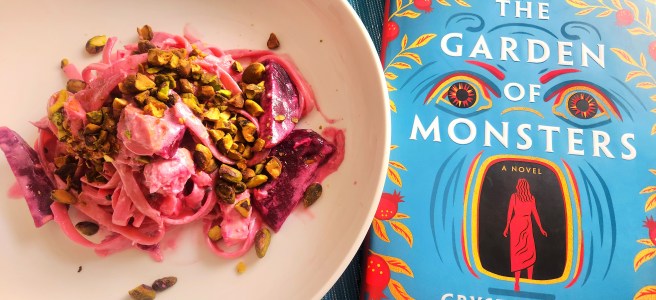
In one of the book’s most lyrical scenes, Dalí insists on serving a multi-course meal served inside the mouth of the monster sculpture and based on the ancient text Hypnerotomachia Poliphili. There are four separate courses based on locations mentioned in that tale and on the elements, all with a different color scheme. I chose the red dinner scene because it’s my favorite color, because the meal is supposed to represent the Fields of Mourning, and because the idea of beet pasta with cheese and pistachios sounded absolutely divine. I used Gorgonzola and added salmon for my own unique take on it.

“I concentrated on my plate, thinking about the dead queen lost to the Fields of Mourning……instead, I focused on the wild array of red dishes that continued to appear on the table: tomato-and-red pepper tarts, steak tartare, beet pasta with goat cheese and pistachios, little dishes of roasted red potatoes, blood orange pies, red cakes, and tiny bowls of grapes and cherries.“

INGREDIENTS
3 large beets
2 cups chicken stock
3 tablespoons olive oil
1 pound fettucine or linguine
8 ounces cooked salmon, flaked
2 cups Gorgonzola, crumbled
1 cup heavy cream
Salt and pepper to taste
1/2 cup pistachios, chopped
METHOD
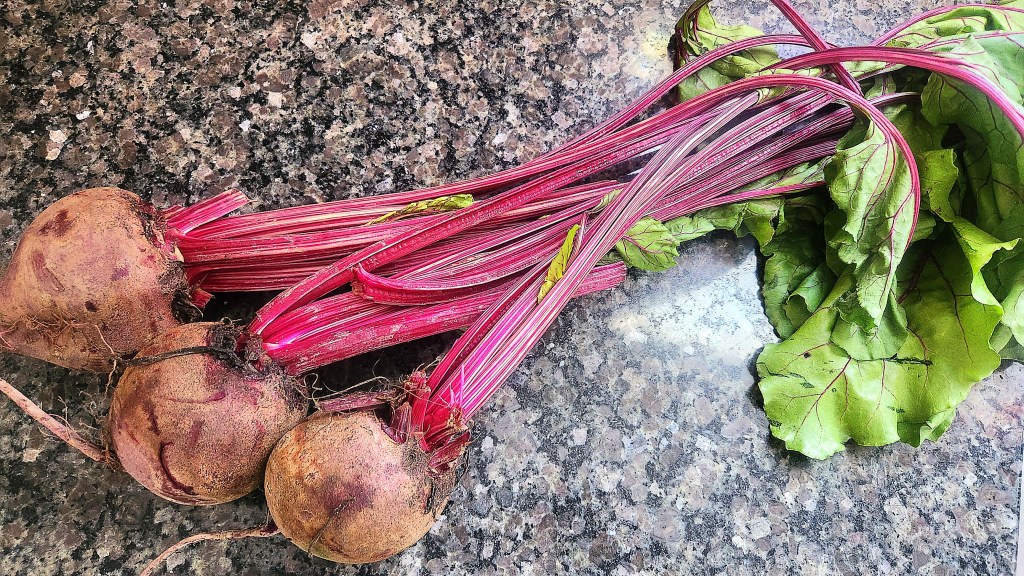
Remove the greens and the stem from the beets. Add to a large pot and pour over the chicken stock. Heat to boil, lower the heat, cover and cook for an hour or until the beets can easily be pierced with a fork.

Let the beets cool, then peel and slice into half-moon shapes and add to a large pan with the olive oil.

Put a large pan of water to boil, then add two tablespoons of salt and the pasta. Cook until al dente, about 2-3 minutes less than what the package says.

Save a cupful of the pasta cooking water and heat the pan with the beets and oil on medium heat. Add in the Gorgonzola and the cream and stir until most of the cheese has melted, but there is still some texture to the sauce.

Add in the flaked salmon, stir to combine and taste for seasoning. Adjust as needed.

Add in the pasta a tongful at a time, gently stirring after each addition, and add the pasta water to loosen the sauce. The pasta and the cream will turn a gorgeous shade of reddish pink.

Garnish with the chopped pistachios, plate as though you were trying to impress Salvador Dalí himself, and devour. I feel Hades himself might leave the Underworld to try this dish.


Thank you!!
LikeLike
I totally feel you about canned beets. That is the reason I wouldn’t eat them for many years, but i’ve discovered them as an adult and now I cannot live without them.
LikeLiked by 1 person
Oh those canned beets we had at our school hot lunches. YUK! They probably turned a lot of people off of beets which is a shame. I love beets but this is something that is beyond anything I could image! Amazing!
LikeLiked by 1 person
Welcome back! Our whole family would love this meal–we’re always looking for new things to do with beets.
LikeLiked by 1 person
Thank you! I think you would really enjoy it.
LikeLiked by 1 person
Although I’m not a fan of beets, this looks so good I’d probably give it a try and be happy!
Always loved that myth as well, and I tell it to the grandkids when we thwack open a pomegranate!
LikeLiked by 1 person
I never liked them much either from childhood because those canned ones were so disgusting. But i’ve grown to love them as an adult. And I just love how you keep the mythology alive for your grandkids. Awesome way to do that and to open a pomegranate.
LikeLiked by 1 person